History
The trans-LINK Canada Network is the evolution and expansion of the Ontario trans-LINK Network (June 2019 to June 2023). Below you can read about the development of the provincial network, its achievements, and access project newsletters and acknowledgments.
Development of the Provincial Network
Established an intersectoral Ontario network on trans-affirming practice to support sexual assault survivors
Context
In Ontario, approximately 20% of trans persons report lifetime experiences of sexual and/or physical violence as a direct result of their gender identity (Bauer & Scheim, 2015). Despite this, many trans persons delay or avoid seeking the care they need due to past and/or anticipated experiences of stigmatization, discrimination, and mistreatment in healthcare settings (Bauer, Scheim, Deutsch, & Massarella, 2014). Furthermore, while most trans services and supports are located in metropolitan Toronto, a reported 68% of trans Ontarians reside outside this region (Bauer, Michelle, Todd, Matthias, Scanlon, & Travers, 2010).
There was a clear and pressing need for province-wide, intersectoral action to address the issue of sexual violence against trans persons.
Dr. Janice Du Mont of Women’s College Research Institute, Women’s College Hospital collaborated with Egale Canada and the Ontario Network of Sexual Assault/Domestic Violence Treatment Centres (SA/DVTCs) on early stages of the trans-LINK Project – a multiphase initiative devoted to the development of a provincial intersectoral network on trans-affirming practice to better support sexual assault survivors.
Between June 7 and July 11, 2019, 106 representatives from Ontario’s SA/DVTCs and trans-positive community organizations attended one of seven regional Knowledge Mobilization and Community Engagement (KM-CE) meetings held in Toronto, Mississauga, North York, London, Ottawa, Sudbury, and Thunder Bay. A primary objective of these sessions was to connect service providers across sectors and regions in the hopes of establishing longer-term referral relationships, increasing collaboration, and enhancing the continuum of care for trans survivors across the province.
-
![19 of the attendees from Central Meeting]()
Central, Toronto Meeting
June 7, 2019
-
![20 of the attendees from Central West Meeting]()
Central West, Mississauga Meeting
June 11, 2019
-
![16 of the attendees from Central East Meeting]()
Central East, North York Meeting
June 19, 2019
-
![24 of the attendees from Southwest Meeting]()
Southwest, London Meeting
June 24, 2019
-
![15 of the attendees from Eastern Meeting]()
Eastern, Ottawa Meeting
June 27, 2019
-
![7 of the attendees from Northeast Meeting]()
Northeast, Sudbury Meeting
July 2, 2019
-
![13 of the attendees from Northwest Meeting]()
Northwest, Thunder Bay
July 11, 2019


References
Bauer, G., & Scheim, A. (2015). Transgender people in Ontario, Canada: Statistics to inform human rights policy. Retrieved from: http://transpulseproject.ca/wp-content/uploads/2015/06/Trans-PULSE-Statistics-Relevant-for-Human-Rights-Policy-June-2015.pdf
Bauer, G., Scheim, A., Deutsch, M., Massarella, C. (2014). Reported emergency department avoidance, use, and experiences of transgender persons in Ontario, Canada: results from a respondent-driven sampling survey. Annals of emergency medicine 2014;63(6):713-20.e1. https://doi.org/10.1016/j.annemergmed.2013.09.027
Bauer, G., Michelle, B., Todd., Matthias, K., Scanlon K., Travers, R. (2010). Who are trans people in Ontario. Trans PULSE e-Bulletin 1, no. 1. Retrieved from: https://www.ohtn.on.ca/Documents/Publications/didyouknow/july28_10/E-Bulletin.pdf
Team
-
![Headshot of Janice Du Mont]()
Janice Du Mont, Project Director
Senior Scientist, Women’s College Research Institute, Women’s College Hospital (she/her)
-
![Headshot of Sheila Macdonald]()
Sheila Macdonald, Principal Knowledge User
Director, Ontario Network of Sexual Assault/Domestic Violence Treatment Centres (she/her)
-
![Headshot of Jakki Buckeridge]()
Jakki Buckeridge, Collaborator
Family Services Manager, Indus Community Services, Mississauga (she/her)
-
![Headshot of Allie Dafoe]()
Allie Dafoe, Collaborator
Program Coordinator, Quinte West Youth Centre, Trenton (she/her)
-
![Headshot of Brittany Jakubiec]()
Brittany Jakubiec, Collaborator
Director of Research, Egale Canada (they/them)
-
![Headshot of Yasmeen Persad]()
Yasmeen Persad, Collaborator
Facilitator, Education & Training, The 519, Toronto (she/her)
-
![Headshot of Brigitte Richard]()
Brigitte Richard, Collaborator
Care Facilitator, Children’s Hospital of Eastern Ontario, Ottawa (she/her)
-
![ARCH logo]()
Jasper Smith, Collaborator
Education Coordinator, HIV/AIDS Resources & Community Health (ARCH), Guelph (they/them)
-
![Headshot of Jessica St. Peter]()
Jessica St. Peter, Collaborator
Manager, Public Education, Sexual Assault Support Centre of Waterloo Region, Kitchener (she/her)
-
![Headshot of Michelle Turner]()
Michelle Turner, Collaborator
Manager, Mental Health and Addictions Program, Sioux Lookout Meno Ya Win Health Centre, Sioux Lookout (she/her)
-
![Headshot of Daisy Kosa]()
S. Daisy Kosa, Staff
Project Coordinator (she/her)
-
![Headshot of Emily Dickson]()
Emily Dickson, Staff
Outreach and Communications Coordinator (she/her)
-
![Headshot of Megan Saad]()
Megan Saad, Staff
Research Assistant (she/her)
-
![Headshot of Joseph Friedman Burley]()
Joseph Friedman Burley, Staff
Research Assistant (he/him)
-
![Headshot of Emma Kelly]()
Emma Kelly, Staff
Research Assistant (she/her)









Trainees
-
![Headshot of Mechaela Alfonso]()
Mechaela Alfonso
MSW (Social Work) Student (she/her)
-
![Headshot of Joseph Friedman Burley]()
Joseph Friedman Burley
MPH (Public Health) Student (he/him)
-
![Headshot of Rachel Cheung]()
Rachel Cheung
MSW (Social Work) Student (she/her)
-
![Headshot of Madelaine Coelho]()
Madelaine Coelho
PhD (Sociology) Student (she/her)
-
![Headshot of Gabrielle Gonsalves]()
Gabrielle Gonsalves
JD (Law), accepted (she/her)
-
![Headshot of Shilini Hemalal]()
Shilini Hemalal
MSc (Medial Science) Student (she/her)
-
![Headshot of Nicholas LeBel]()
Nicholas LeBel
MD (Medicine) Student (he/him)
-
![Headshot of Megan Saad]()
Megan Saad
MPH (Public Health) Student (she/her)
-
![Headshot of Hyuna Seo]()
Hyuna Seo
BHSc (Health Sciences) Student (she/her)
-
![Headshot of Nathalie Villalba]()
Nathalie Villalba
Dip (Health Informatics) Student (she/her)








Peer Leaders
-

Sydney Brouillard-Coyle
(ney/nem/nir)
-

Angelina Grace
(she/her)
-

Suru
(he/they)
Achievements of the Provincial Network
Collaborated with ≈130 trans-led/positive community organizations and violence treatment centres to plan, form, and mature the provincial intersectoral network.
Highlights

Articles
-
![Preview of article]()
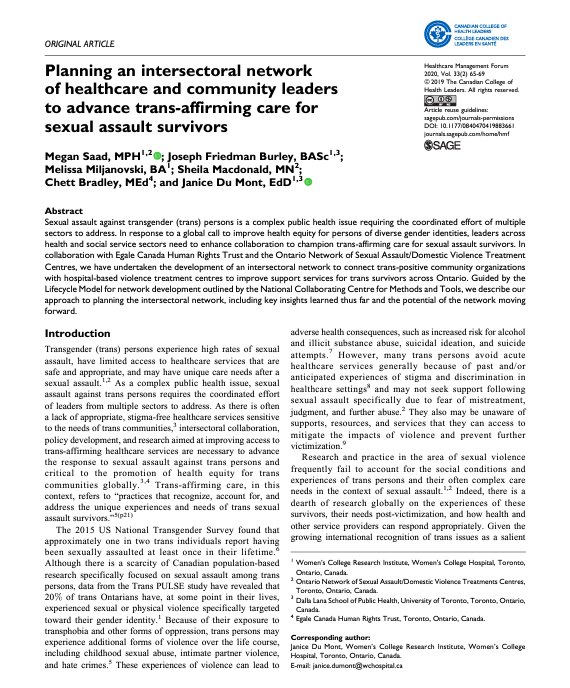
Planning an intersectoral network of healthcare and community leaders to advance trans-affirming care for sexual assault survivors
March 2020
-
![Preview of article]()
Formation of an intersectoral network to support trans survivors of sexual assault: A survey of health and community organizations
July 2020
-
![Preview of article]()
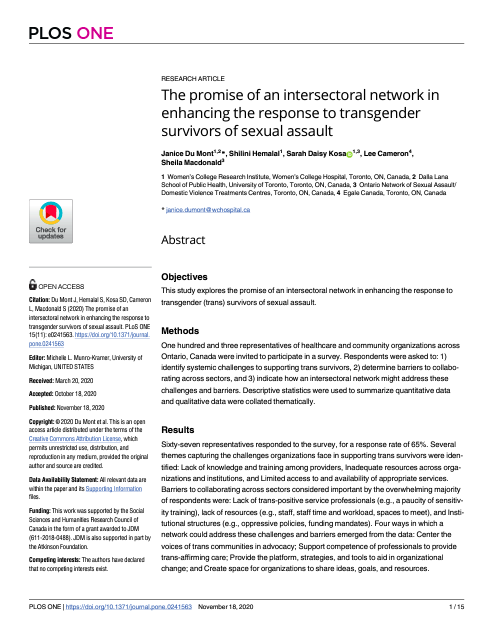
The promise of an intersectoral network in enhancing the response to transgender survivors of sexual assault
November 2020
-
![Preview of article]()
Advancing trans-affirming practice to recognize, account for, and address the unique experiences and needs of transgender sexual assault survivors
April 2021
-
![Preview of article]()
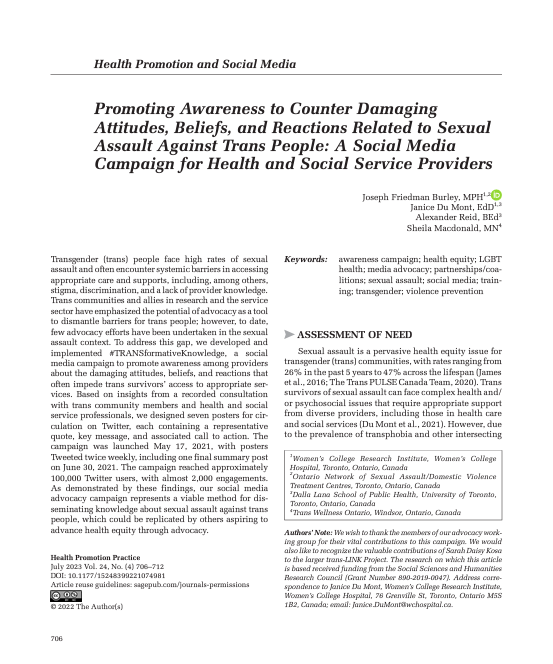
Promoting awareness to counter damaging attitudes, beliefs, and reactions related to sexual assault against trans people: A social media campaign for health and social service providers
March 2022
-
![Preview of article]()
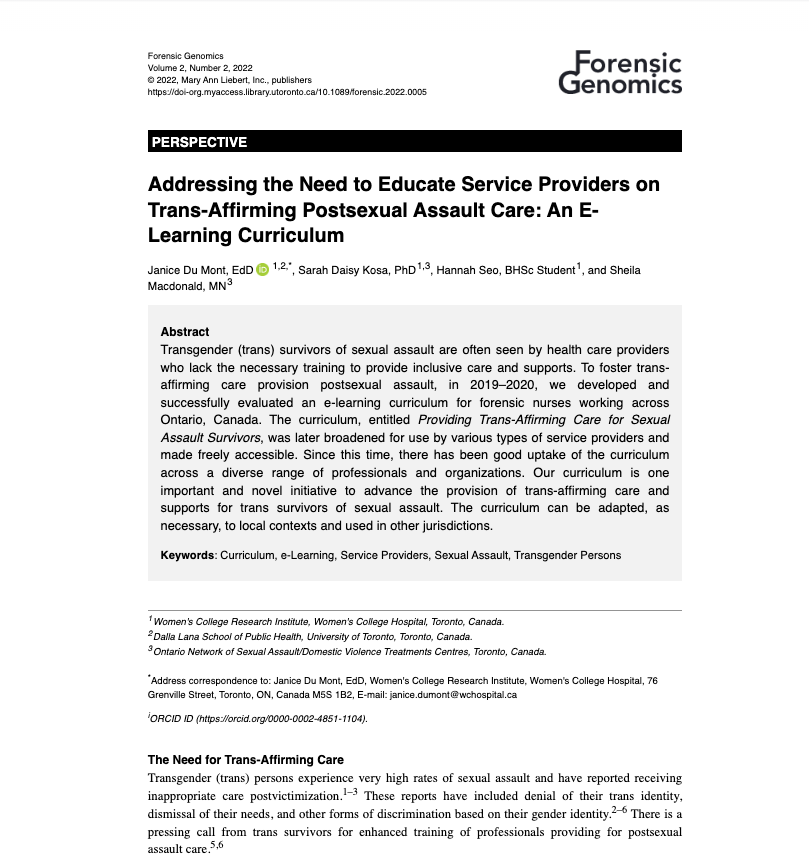
Addressing the need to educate service providers on trans-affirming postsexual assault care: An e-learning curriculum
June 2022
-
![Preview of article]()
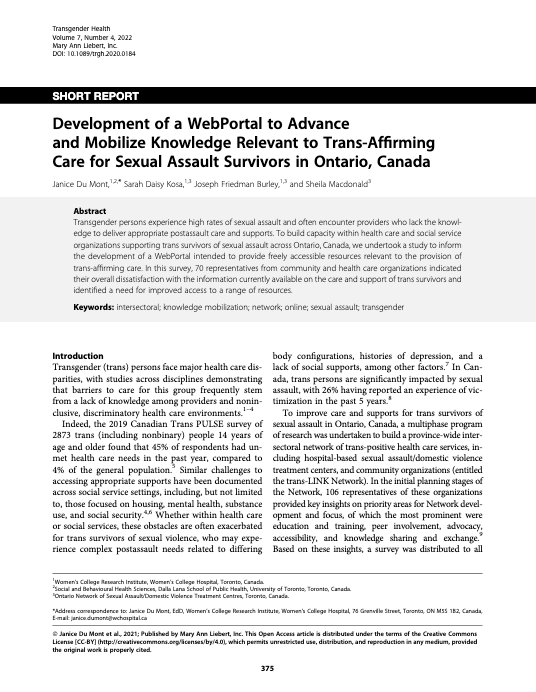
Development of a webportal to advance and mobilize knowledge relevant to trans-affirming care for sexual assault survivors in Ontario, Canada
August 2022
-
![Preview of article]()
Advancing community-engaged research during the COVID-19 pandemic: Insights from a social network analysis of the trans-LINK Network
November 2022
-
![Preview of article]()
Recommendations to improve the nature and extent of relationships among organizations within a network to enhance supports for transgender survivors of sexual assault
March 2023
-
![Preview of article]()
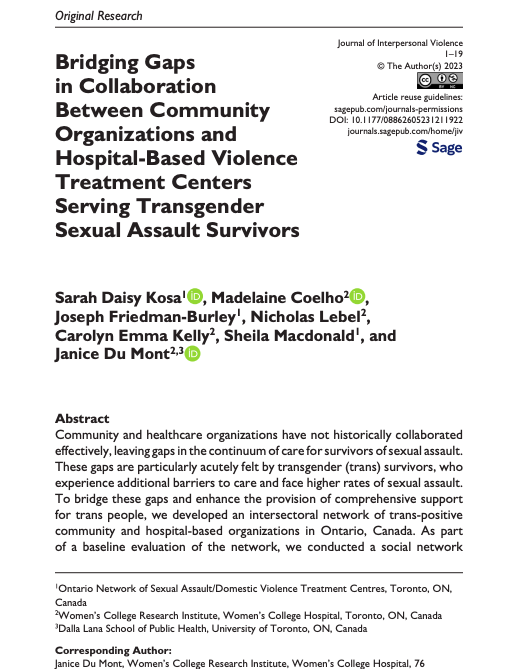
Bridging gaps in collaboration between community organizations and hospital-based violence treatment centers serving transgender sexual assault survivors
November 2023
-
![Preview of article]()
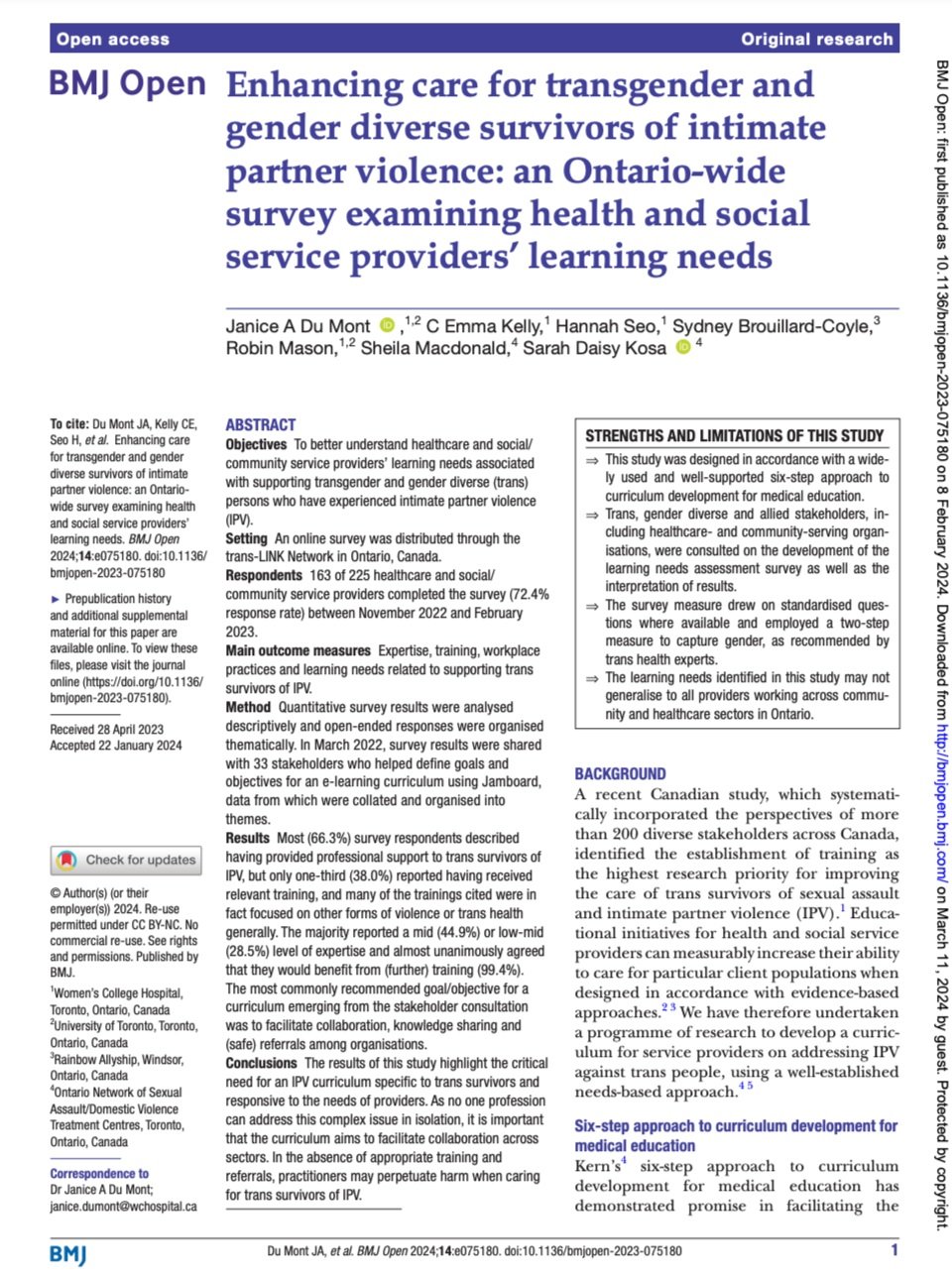
Enhancing care for transgender and gender diverse survivors of intimate partner violence: An Ontario-wide survey examining health and social service providers’ learning needs
February 2024




Abstracts

To view the full abstract, click here.
Du Mont, J., Daisy Kosa, S., Saad, M., & Macdonald, S. (January-December, 2020). Building an intersectoral network to champion supports for trans survivors of sexual assault: Survey findings from health and community leaders. Global Qualitative Nursing Research, 7. doi: 10.1177/ 2333393620932494
Research Briefs

To view the full brief, click here.
Friedman Burley, J., Miljanovski, M., Saad, M., Macdonald, S., Bradley, C., & Du Mont, J. (2019, September). Building a provincial intersectoral network on trans-affirming practice to support sexual assault survivors: Planning stage [Research Brief]. Women’s College Research Institute, Women’s College Hospital, Egale Canada, and the Ontario Network of Sexual Assault/Domestic Violence Treatment Centres. Available from: Women’s College Research Institute, Women’s College Hospital
trans-LINK Network Ontario Directory
This directory was created as part of ongoing efforts to foster connection and collaboration across trans-LINK Network health and community organizations in Ontario. Listings included a brief summary of services as well as up-to-date contact information to aid in consolidating partnerships and making safer and more seamless referrals across sectors and regions. The resource was designed to be of use to those providing services and other supports to trans survivors of sexual assault as well as to survivors themselves.
To view the directory, click here.
Blog Posts

TRANSforming care for survivors of gender-based violence

“It’s important we team up together”: Strengthening relationships to better support transgender survivors of sexual assault
Clinical Summaries


Information Sheets


Infographics


Presentations
-
![Preview of title slide]()
Building an intersectoral network on trans-affirming practice to support sexual assault survivors
July 2019
-
![Preview of poster]()
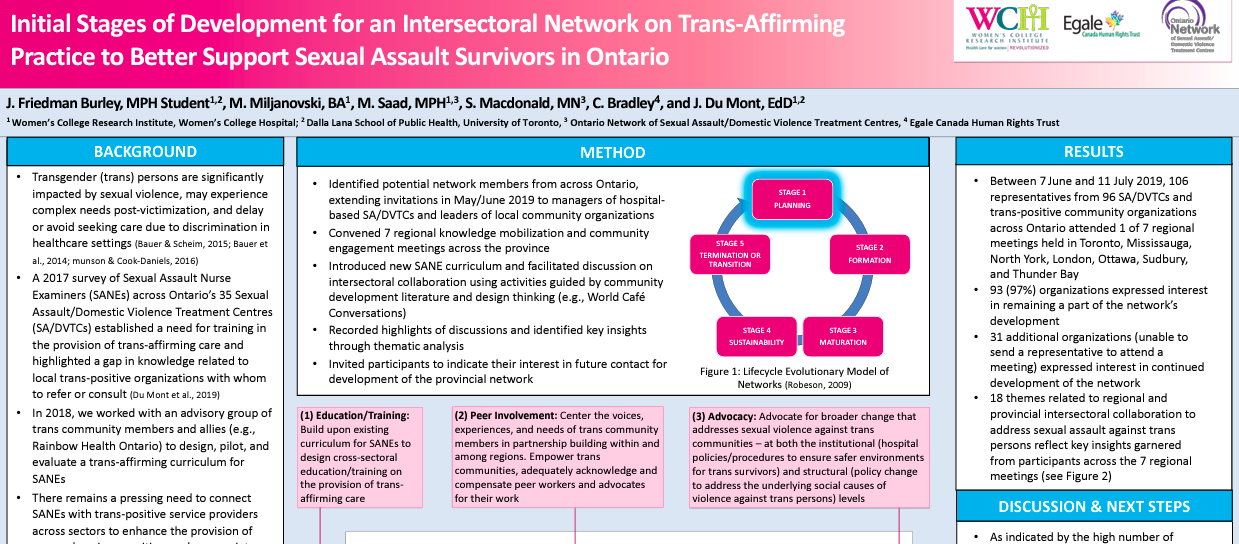
Initial stages of development for an intersectoral network on trans-affirming practice to better support sexual assault survivors in Ontario
November 2019
-
![Preview of title slide]()
Building capacity and mobilizing partnerships to support transgender survivors of sexual assault
November 2020
-
![Preview of title slide]()
Promoting equity in Ontario’s response to sexual assault against trans persons
November 2020
-
![Preview of title slide]()
Enhancing the response to trans persons who have experienced sexual assault
November 2020
-
![Preview of title slide]()
The trans-LINK WebPortal: Enhancing access to resources for trans-affirming post-sexual assault care
April 2021
-
![Preview of title slide]()
Promoting trans-affirming practice to better respond to transgender sexual assault survivors
April 2021
-
![Preview of title slide]()
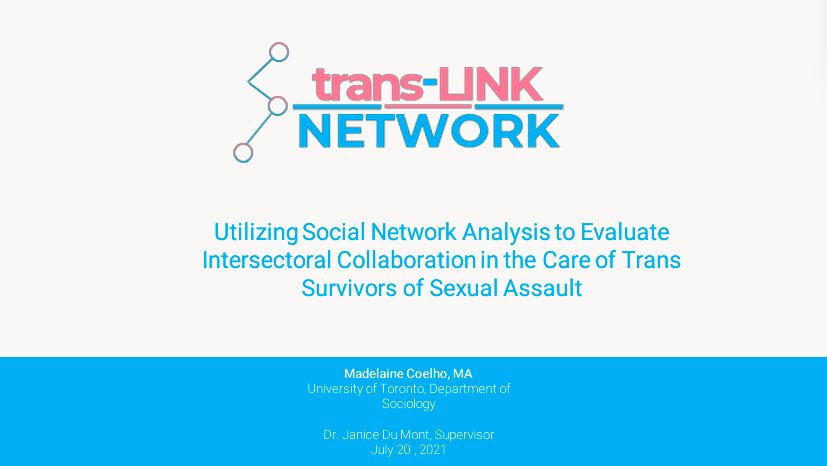
Utilizing social network analysis to evaluate intersectoral collaboration in the care of trans survivors of sexual assault
July 2021
-
![Preview of title slide]()
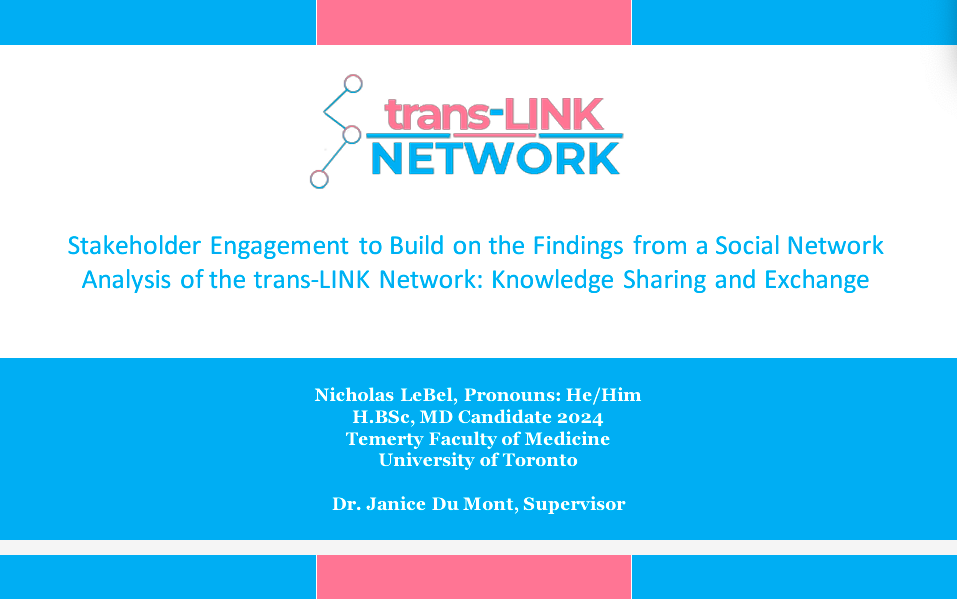
Stakeholder engagement to build on the findings from a social network analysis of the trans-LINK Network: Knowledge sharing and exchange
July 2021
-
![Preview of title slide]()
Building a Canadian research agenda to address gender-based violence against trans people: Initial findings from a survey of diverse stakeholders
July 2021
-
![Preview of title slide]()
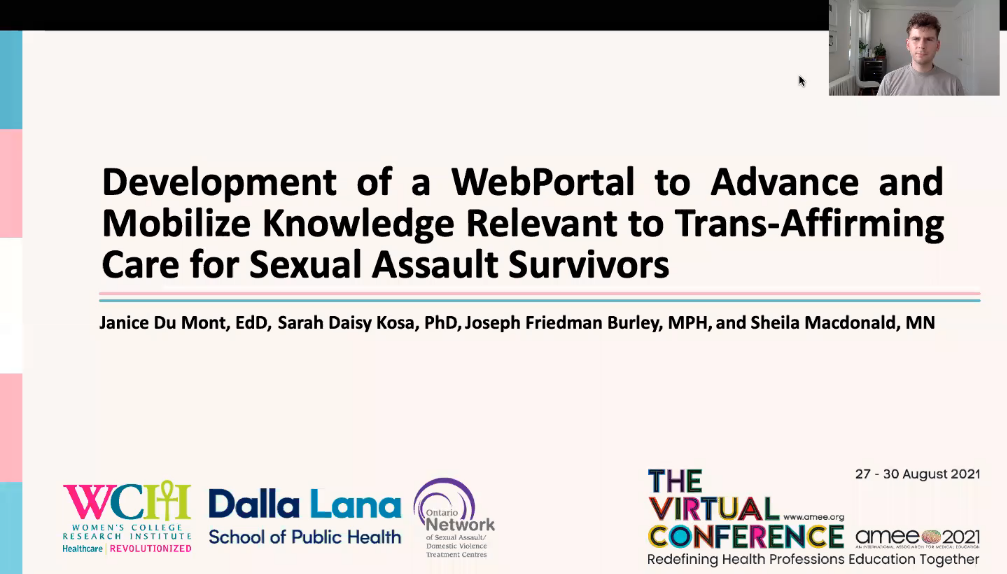
Development of a WebPortal to mobilize knowledge on the care and support of transgender sexual assault survivors
August 2021
-
![Preview of poster]()
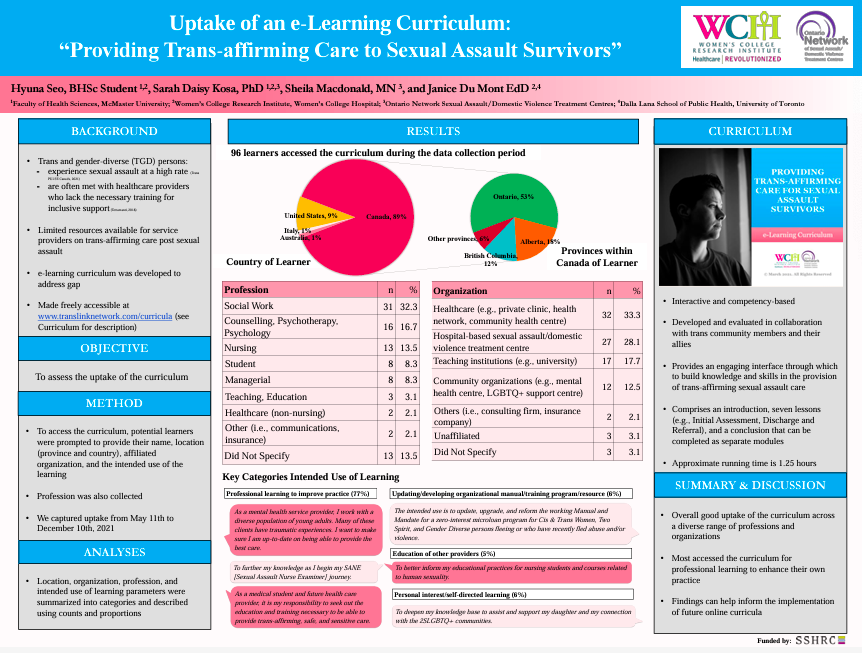
Uptake of an e-learning Curriculum: “Providing trans-affirming care to sexual assault survivors
Feb 2022
-
![Preview of poster]()
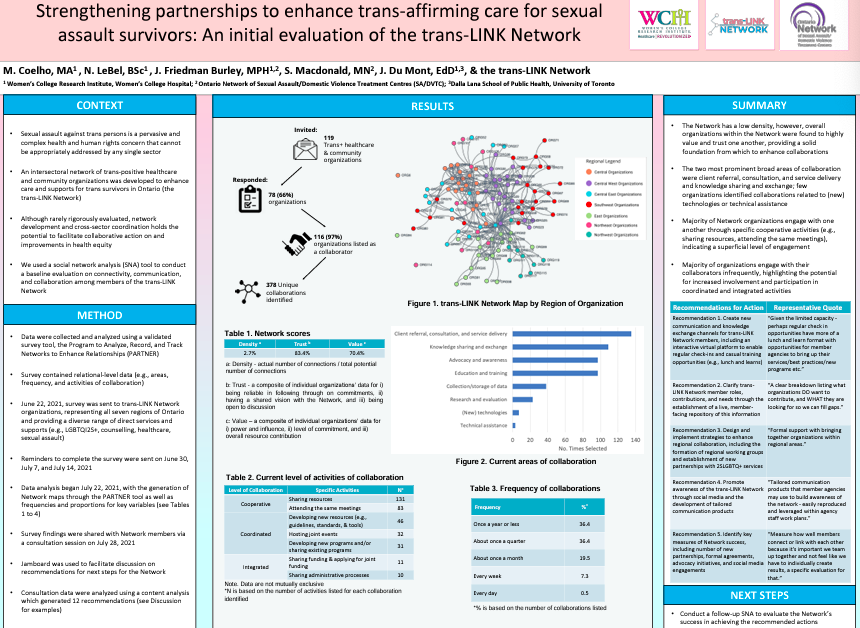
Strengthening partnerships to enhance trans-affirming care for sexual assault survivors: An initial evaluation of an intersectoral network of health and community service providers
May 2022
-
![Preview of poster]()
Promoting awareness to counter damaging attitudes, beliefs, and reactions related to sexual assault against trans people: #TRANSformativeKnowledge, a campaign for health and social service providers
May 2022
-
![Preview of poster]()
Determining research priorities in gender-based violence against trans persons: Initial findings from a multistakeholder survey
May 2022
-
![Preview of title slide]()
Developing an intimate partner violence curriculum: A learning needs assessment
July 2022
-
![Preview of poster]()
Building a research agenda on addressing sexual assault and intimate partner violence against trans and gender diverse people: Differences in priorities by gender
May 2023
-
![Preview of poster]()
The importance of addressing the unique needs of transgender and gender diverse survivors of intimate partner violence: Findings from a learning needs assessment survey of Ontario service providers
May 2023
-
![Preview of poster]()
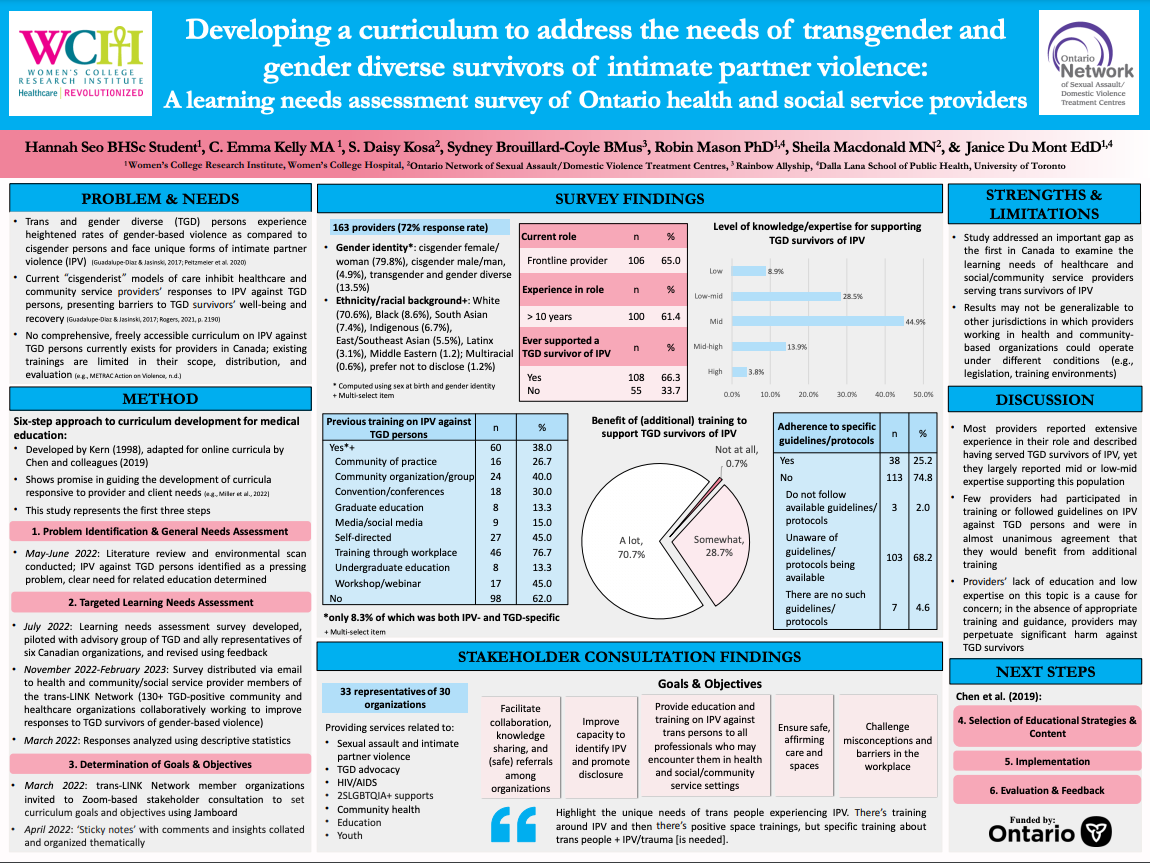
Developing a curriculum to address the needs of transgender and gender diverse survivors of intimate partner violence: A learning needs assessment survey of Ontario health and social service providers
May 2023
-
![Preview of poster]()
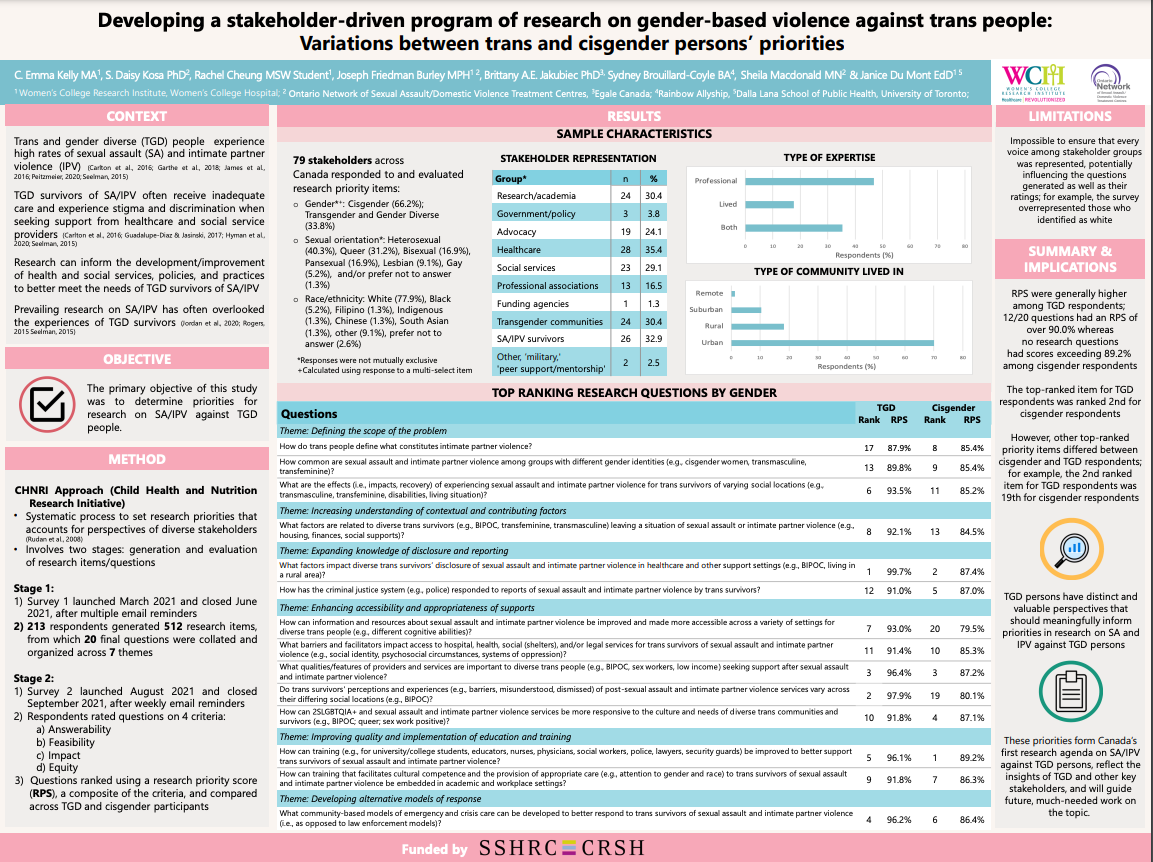
Developing a stakeholder-driven program of research on gender-based violence against trans people: Variations between trans and cisgender persons’ priorities
May 2023






Webinars



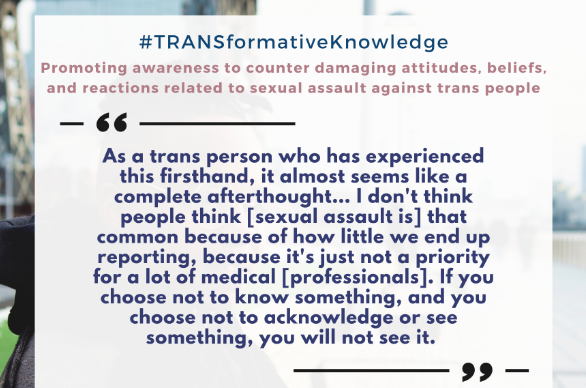
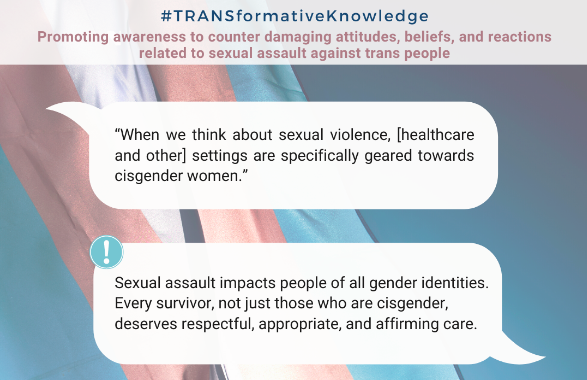
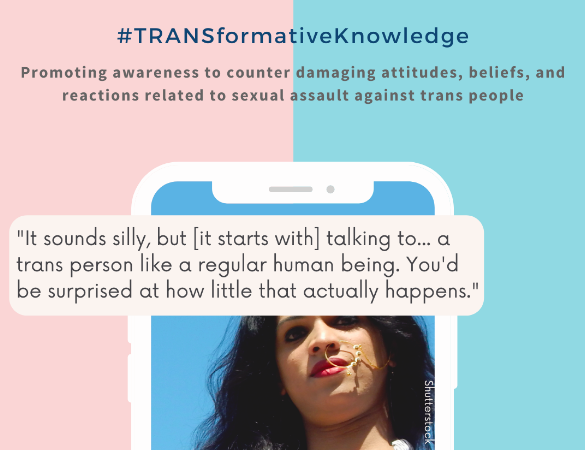
Advocacy Campaign
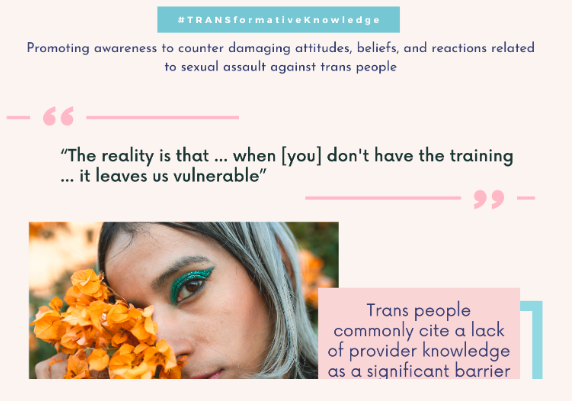
#TRANSformative Knowledge
Promoting awareness to counter damaging attitudes, beliefs, and reactions related to sexual assault against trans people.
This advocacy campaign was a collaboration among Women’s College Research Institute, Women’s College Hospital, Trans Wellness Ontario, and the Ontario Network of Sexual Assault/Domestic Violence Treatment Centres.
The advocacy posters, organized by theme below, arose out of a focus group of trans peer leaders and allied health and social service providers, who helped develop and approved all campaign messaging.
-
![Preview of poster]()
Theme: 'A Complete Afterthought'
-
![Preview of poster]()
Theme: 'A Complete Afterthought'
-
![Preview of poster]()
Theme: 'Healing is Inhibited'
-
![Preview of poster]()
Theme: 'A Regular Human Being'
-
![Preview of poster]()
Theme: ‘The Treatment is the Trauma’
-
![Preview of poster]()
Theme: ‘The Virtuous Victim’
-
![Preview of poster]()
Theme: ‘Incompetent to Care’



Newsletters
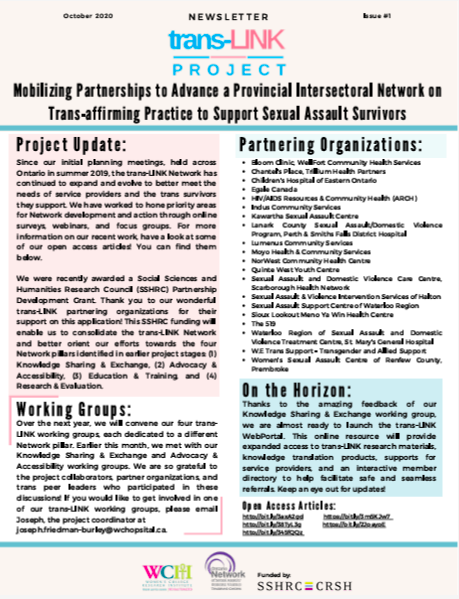
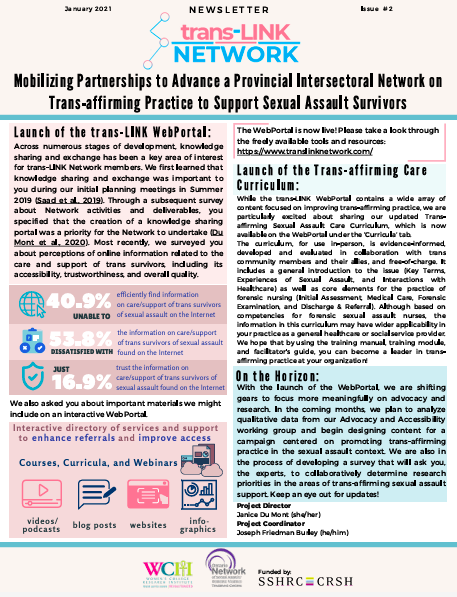
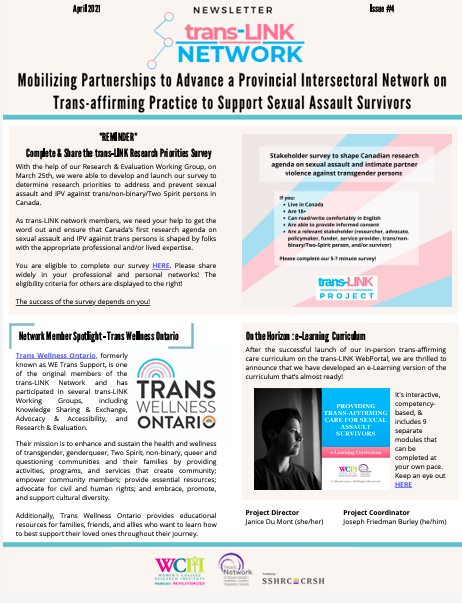
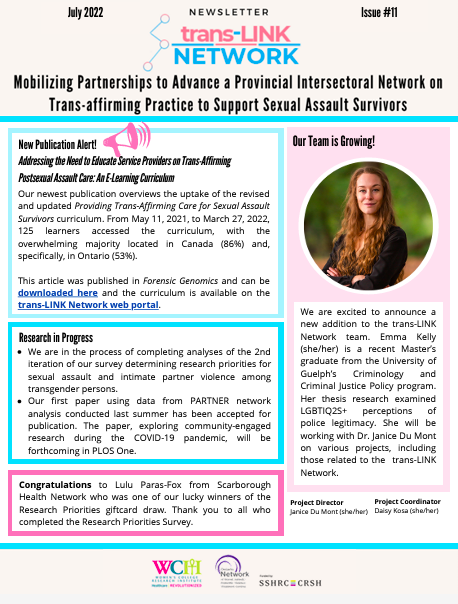
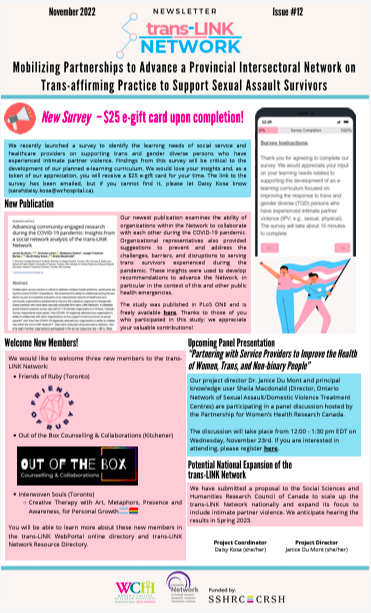
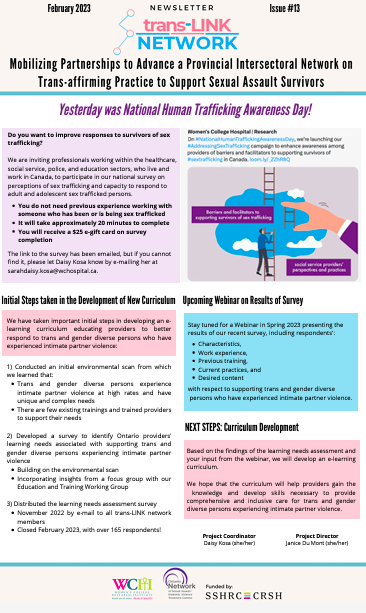
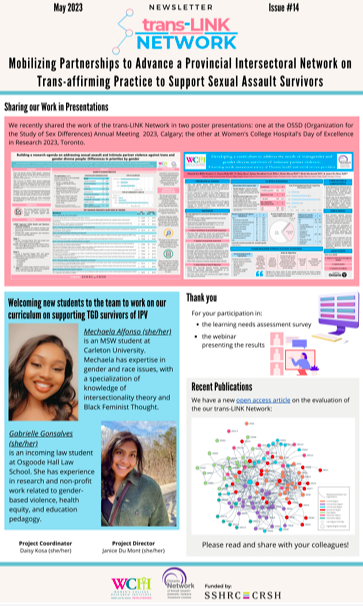
Key activities and advancements of the provincial network were captured in regularly disseminated project newsletters.
-
![Preview of newsletter]()
Issue #1
October 2020
-
![Preview of newsletter]()
Issue #2
January 2021
-
![Preview of newsletter]()
Issue #3
March 2021
-
![Preview of newsletter]()
Issue #4
April 2021
-
![Preview of newsletter]()
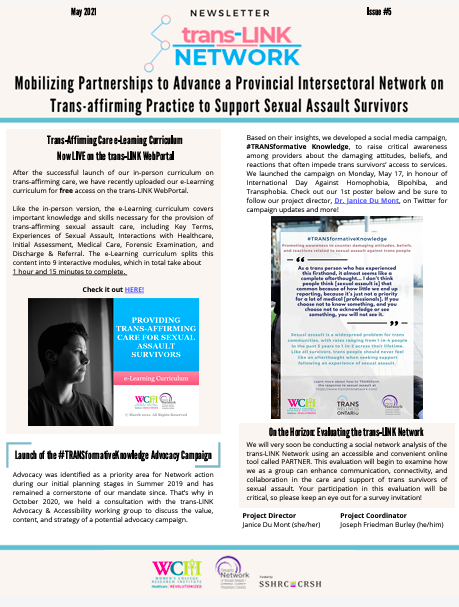
Issue #5
May 2021
-
![Preview of newsletter]()
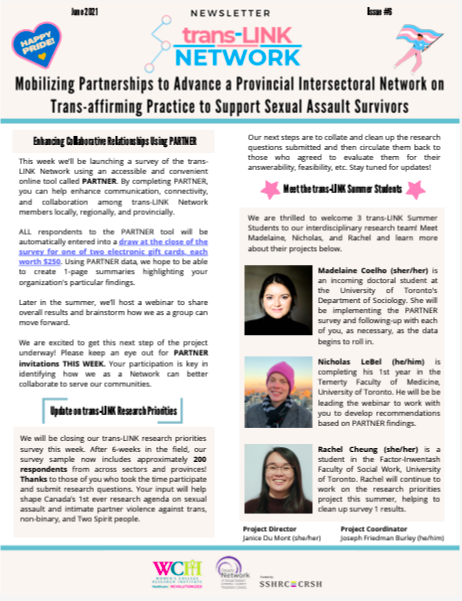
Issue #6
June 2021
-
![Preview of newsletter]()
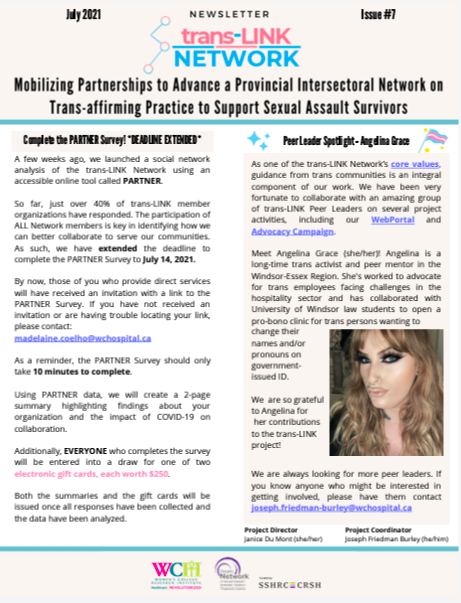
Issue #7
July 2021
-
![Preview of newsletter]()
Issue #8
September 2021
-
![Preview of newsletter]()
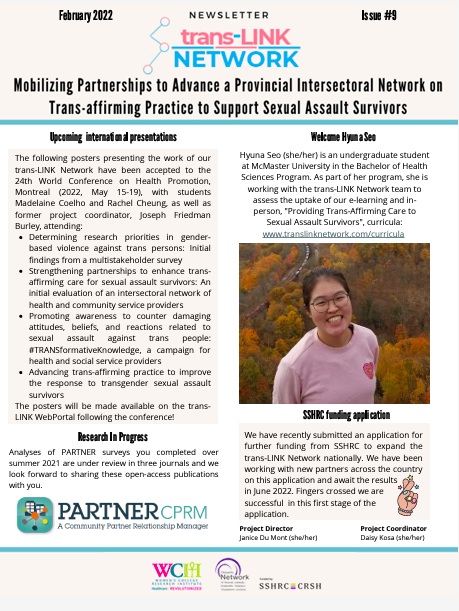
Issue #9
February 2022
-
![Preview of newsletter]()
Issue #10
May 2022
-
![Preview of newsletter]()
Issue #11
July 2022
-
![Preview of newsletter]()
Issue #12
November 2022
-
![Preview of newsletter]()
Issue #13
February 2023
-
![Preview of newsletter]()
Issue #14
May 2023



Acknowledgments
Our work at Women’s College Research Institute, Women’s College Hospital and the Ontario Network of Sexual Assault/Domestic Violence Treatment Centres took place on traditional Indigenous territories across Ontario. We also acknowledge that Women’s College Hospital is located on the traditional Indigenous territories of the Huron-Wendat, Haudenosaunee, and the territory of the Mississaugas of the Credit First Nations. Today, the meeting place of Toronto is still the home to many Indigenous people from across Turtle Island, and we are grateful to have had the opportunity to work in this territory.
Additionally, we extend our gratitude to the Social Sciences and Humanities Research Council of Canada for their funding, which was instrumental in advancing this work.